
The short answer: Ask for the actual records for the individual dogs, understand what each test does and does not show, and work with your veterinarian on your puppy’s care. Health screening reduces uncertainty; it does not promise a disease-free dog.
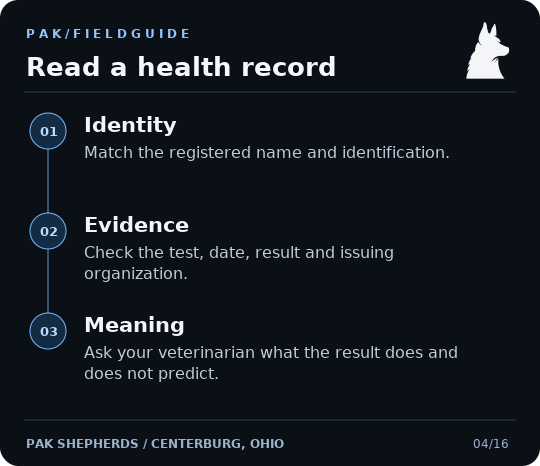
Read the graphic as text
- Identity: Match the registered name and identification.
- Evidence: Check the test, date, result and issuing organization.
- Meaning: Ask your veterinarian what the result does and does not predict.
Read the record, not just the headline
When a breeder says “health tested,” ask which dog was tested, which test was performed, the testing organization, the date, and the result. Match the registered name and identification to the dog being discussed. A general statement about a kennel is not a substitute for documentation for a particular parent.
The German Shepherd Dog Club of America identifies hip and elbow evaluation within its health resources. Different evaluations and genetic tests answer different questions. Ask the issuing organization or your veterinarian to explain results you do not understand instead of treating every abbreviation as interchangeable.
What does a CHIC number mean?
The Orthopedic Foundation for Animals explains that a CHIC number indicates completion and public disclosure of the breed-specific required screening. It does not mean that every result is normal. Read the individual results behind the number.
Do not assume that every dog on this website has a CHIC number or the same set of tests. Open each dog’s profile and ask PAK for the relevant available documentation. A title, registration, or photograph is not a replacement for health records.
Plan your puppy’s care with your veterinarian
Bring the puppy’s records to your veterinary appointment and agree on a follow-up plan. Ask about vaccine timing, local exposure risks, parasite prevention, nutrition, growth, and identification. A plan should account for the puppy’s age, history, and circumstances rather than copy a universal schedule from a website.
Keep a folder with dated records and note any concerns to discuss. Confirm how your practice handles urgent questions outside normal hours. If your dog seems unwell, contact a veterinarian rather than using an educational article to decide on treatment.
Questions to take into a breeder conversation
- Can I see the available health records for the sire and dam?
- Which results are final, preliminary, or still pending?
- What veterinary care and records will accompany the puppy?
- What does the written agreement cover, and what are its limits?
- Who should I contact after pickup if I have a concern?
Continue with the puppy buyer checklist and your first weeks at home. This page is breeder education, not a veterinary diagnosis or a veterinary-reviewed medical guide.
Sources and further reading
These independent resources support the general guidance above. Their inclusion does not imply an endorsement of PAK Shepherds.
- OFA: CHIC Program and the meaning of CHIC certification
- German Shepherd Dog Club of America: Health & Genetics
- VCA: Veterinary Care Recommendations for Puppies
Published November 25, 2026. Written for the PAK Shepherds Knowledge Hub. General education, not individual veterinary or behavior advice.