
The short answer: Begin with simple behaviors that make everyday life easier, teach them in manageable settings, and practice consistently. Choose support that helps both you and your dog learn.
Read the graphic as text
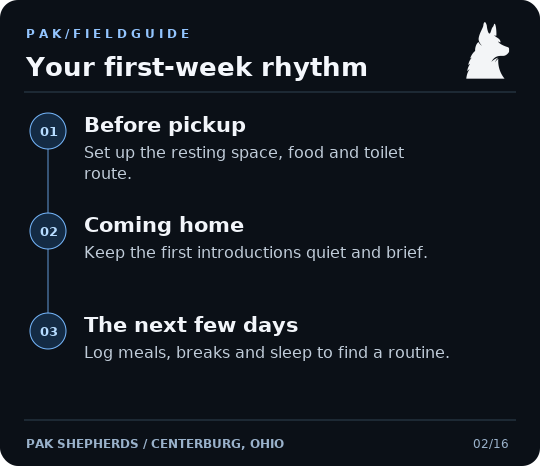
- Before pickup: Set up the resting space, food and toilet route.
- Coming home: Keep the first introductions quiet and brief.
- The next few days: Log meals, breaks and sleep to find a routine.
Decide what success looks like at home
Start with a short list: responding to a name, coming when called in a secure setting, walking with you, resting in a designated space, and allowing gentle handling. Describe each goal in observable terms. “Be good” is vague; “rest on a mat while we prepare dinner” gives you something to practice.
Use the same words and expectations across the household. Keep a note of what you practiced, the setting, and what made it easier or harder. That record is useful when you speak with a trainer.
Make learning clear and achievable
The American Veterinary Society of Animal Behavior recommends reward-based training. Set up opportunities to reward the behavior you want, and adjust the environment when the task is too difficult. Avoid turning a new exercise into a test the puppy is not prepared to pass.
Practice in a quiet place before adding distractions. A response in your kitchen does not automatically transfer to a busy sidewalk. Work within secure spaces and use suitable management rather than relying on an unproven recall near roads.
Connect training with daily care
A useful plan includes rest, meals, outdoor breaks, and time with people. Training does not need to exist only as a formal class. You can prepare for a walk calmly, reward attention, and practice brief handling as part of daily life.
Read our puppy raising guide to connect these goals to the first days at home. For questions about unfamiliar people and environments, see puppy socialization.
Choose support before you feel stuck
Ask a prospective trainer how they teach, what you will practice between lessons, and how they respond when a dog is fearful or struggling. Ask about relevant education and experience, and whether you can observe a class. Be cautious about guaranteed results or fixed timelines that ignore the individual dog.
For aggression, significant fear, or a sudden behavior change, involve your veterinarian and seek qualified behavior support. Keep people and animals safe while you arrange help. Tell PAK what you are seeing using specific examples rather than labels.
Sources and further reading
These independent resources support the general guidance above. Their inclusion does not imply an endorsement of PAK Shepherds.
Published November 25, 2026. Written for the PAK Shepherds Knowledge Hub. General education, not individual veterinary or behavior advice.